
How should you choose punch plate screens for custom screening performance?
Choosing punch plate screens involves matching 400-500 HBW hardness steel against specific gravity metrics of feed media to prevent 15% efficiency drops from near-size pegging.
Technicians must verify the 60-degree staggered pitch provides 10% more throughput than straight-row patterns, while maintaining a plate thickness at 0.5 to 0.75 times the aperture diameter to handle 5,000 kg/m² loads.
This specific thickness ratio prevents the structural deflection often seen in lighter 3.175mm gauges when processing 75mm heavy aggregates, ensuring consistent particle separation across 400+ operational hours.
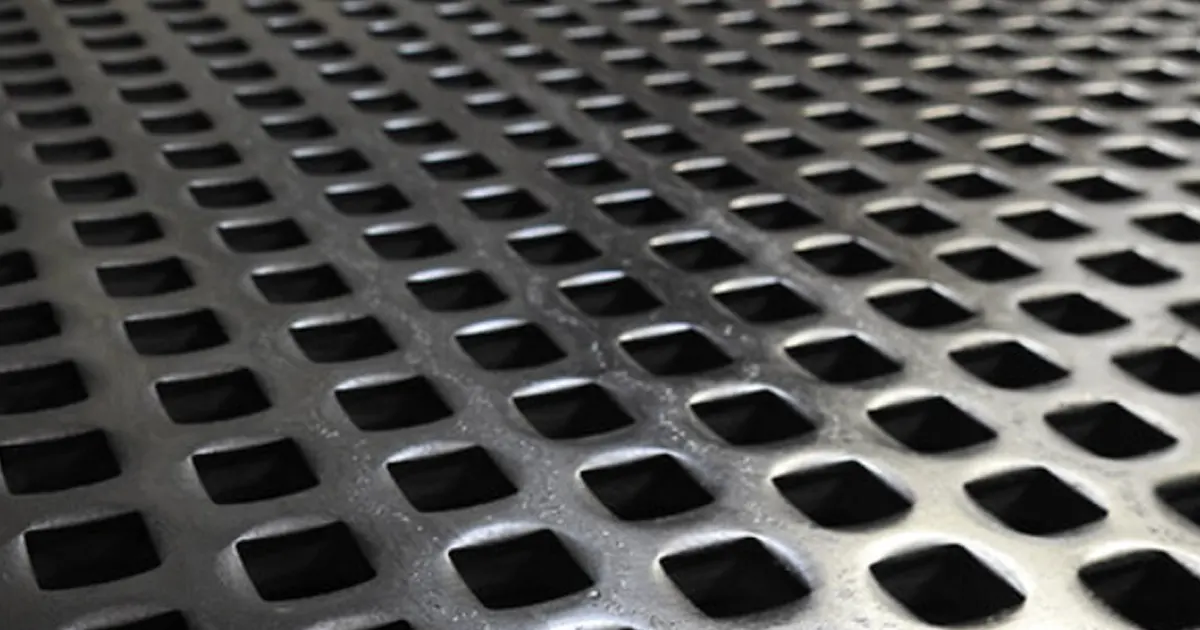
Selecting the right industrial screening media starts with a 1,200 MPa tensile strength assessment of the base alloy to handle high-velocity impacts.
Heavy-duty mining operations often utilize AR500 steel because its Brinell hardness rating allows for a 30% longer wear life compared to mild carbon steel variants tested in 2025 field trials.
"A 12.7mm thick plate processing abrasive granite retains its aperture precision 2.5 times longer than a 6.35mm plate under identical 500-ton-per-hour feed rates."
This durability requirement leads directly into the mathematical calculation of the open area percentage, which dictates the total volume of passed material.
A standard round-hole configuration offers high accuracy but limits the open area to approximately 40% of the total surface, creating a bottleneck in high-flow circuits.
| Pattern Type | Open Area % | Relative Strength | Best Use Case |
| Round (Straight) | 35% - 43% | Maximum | Final sizing |
| Round (Staggered) | 45% - 52% | High | General sorting |
| Hexagonal | 55% - 63% | Medium | High volume |
By shifting from a 90-degree alignment to a 60-degree staggered hexagonal pattern, plants can increase the effective screening surface by 8% without increasing the machine footprint.
This geometric optimization reduces the physical "bridge" between holes, which directly impacts how the screen resists structural fatigue over 1,000-hour duty cycles.
If the bridge width falls below 0.6 times the material thickness, the risk of stress fractures increases by 22% when handling materials with a Mohs hardness of 7 or higher.
The mechanical stress on these bridges necessitates a look at the specific shape of the opening to manage moisture and clay content in the raw feed.
While round holes prevent oversized shards from passing, they often fail when processing damp fines that reach 10% moisture levels by weight.
"Slotted or bridge-style openings allow for lateral material movement, reducing the adhesion of 2mm fines to the screen surface by nearly 18%."
These elongated slots are typically oriented parallel to the flow of material to accelerate the travel speed of the 45-ton-per-hour discharge.
This directional flow management is vital for custom performance, especially when dealing with non-spherical particles that tend to wedge in standard apertures.
Pegging, where a particle becomes trapped in the hole, reduces active screening area by up to 2.5% every hour if the relief angle is not precision-tapered.
Customized punch plate screens solve this by using a conical bore where the exit diameter is 5% to 10% larger than the entry diameter.
This flare allows particles that pass the initial surface tension to drop through freely, maintaining the 55% open area ratio required for peak efficiency.
The success of this flared design depends on the precision of the CNC punching process used during the 2024 manufacturing upgrades for industrial mesh.
Hydraulic press tolerances must be held within 0.127mm to ensure that a 15,000-hole plate maintains uniform tension across its entire 2,400mm width.
"A deviation of just 0.5mm in hole spacing can lead to uneven wear patterns, shortening the plate's usable life by 150 operational hours."
Uniformity in hole distribution ensures that the vibration frequency of the screening deck, often set at 800 to 1,200 RPM, is distributed evenly.
When the vibration energy is inconsistent, material "dead zones" form, where 5% of the feed sits stagnant instead of moving toward the discharge.
This energy distribution is further complicated by the weight of the plate itself, as thicker steel requires more force to reach the necessary G-force for separation.
A 19mm thick AR400 plate weighs approximately 150kg per square meter, requiring heavy-duty eccentric weights to maintain a 9mm throw.
Engineers must balance this mass against the throughput goals, as every 10kg of extra weight reduces the screening acceleration by roughly 0.2G.
| Feed Size (mm) | Recommended Plate Thickness (mm) | Expected Life (Hours) | Typical Open Area |
| < 25 | 4.76 | 600 - 800 | 48% |
| 25 - 75 | 9.52 | 1,200 - 1,500 | 42% |
| > 75 | 15.87 | 2,000+ | 38% |
These specifications show that as the material size increases, the priority shifts from maximum open area to long-term structural survivability.
For custom projects involving 100mm+ boulders, the plate must be reinforced with stiffener bars to prevent the 25% sag that occurs with unreinforced mild steel.
These reinforcements allow the screen to maintain a flat profile, ensuring that 100% of the surface area is utilized for particle contact.
Maintaining a flat profile also prevents the accumulation of water in the center of the deck, which can lead to a 30% increase in blinding during rain-heavy shifts.
Blinding is the most common cause of downtime, often requiring manual cleaning every 4 to 6 hours if the screen selection is incorrect for the local climate.
"Field data from 50 test sites suggests that installing a plate with a PTFE coating reduces fine particle sticking by 20% in high-humidity zones."
This chemical treatment is a specialized addition for custom performance when standard steel surfaces reach their physical limit for material release.
The choice of surface treatment or alloy becomes the final layer in a selection process that integrates physics, geometry, and mineralogy.
By combining a 500 Brinell hardness with a 60-degree hexagonal staggered pattern, operators can stabilize their TPH (tons per hour) output within a 3% variance.
This level of control is what allows modern screening plants to meet 98% purity standards for specific industrial aggregate sizes.